
On 9 November 2026, Anthropic announced Claude Fable 5.2 and Claude Mythos 5.2. Fable 5.2 is open to everyone; Mythos 5.2 goes only to verified organizations. Three differences from Fable 5.1 stand out: the price per million tokens dropped from $10/$50 to $8/$40, output is up to 30% faster according to Anthropic, and the safety filters block less by mistake. Below we pulled the numbers, the benchmarks and the breaking changes for developers from primary sources.
In short: what changed with Fable 5.2?
A quick history of the Fable family: Fable 5 shipped on 9 June 2026. Fable 5.1 arrived in September 2026 at the same price as Fable 5. Fable 5.2 followed about two months later at a lower price.
| Feature | Fable 5.1 | Fable 5.2 |
|---|---|---|
| Input price (1M tokens) | $10 | $8 |
| Output price (1M tokens) | $50 | $40 |
| Output speed | baseline | up to 30% faster than 5.1 |
| Context window / max output | 1M / 128K tokens | 1M / 128K tokens |
| Safety filter blocks | baseline | about 55% fewer in Anthropic's early testing |
| API model ID | claude-fable-5-1 |
claude-fable-5-2 |
The price fell 20% on both items (8/10 and 40/50). Our arithmetic: a workload of 1 million input and 200 thousand output tokens costs $20 on 5.1 and $16 on 5.2. Cache reads cost $0.20 per million tokens, and batch processing is $4 input / $20 output. Fable 5.2 also offers an optional fast mode that speeds up generation by up to 2.5 times for $16 input / $80 output. Pricing and features are listed in Anthropic's Fable 5.2 docs.
Fable and Mythos are the same model
According to Anthropic, Fable and Mythos are the same underlying model; the difference is in the safeguards. Fable has strong cybersecurity and biology safeguards, which is why it can be offered to everyone. Mythos has looser safeguards and is given only to organizations in the Cyber Verification and Life Sciences Verification programs.
In practice, Fable 5.2 may decline high-risk work such as penetration testing, exploit generation and research biology; blocked requests are answered by Opus 4.8 for cybersecurity and Opus 5 for biology.
Benchmarks: the scores Anthropic published
The scores below come from the table on Anthropic's announcement page. The measurements are Anthropic's own; scores are reported with safeguards on and mostly at each model's highest effort level. Instead of copying Anthropic's original graphics, we moved the numbers into our own table and chart.
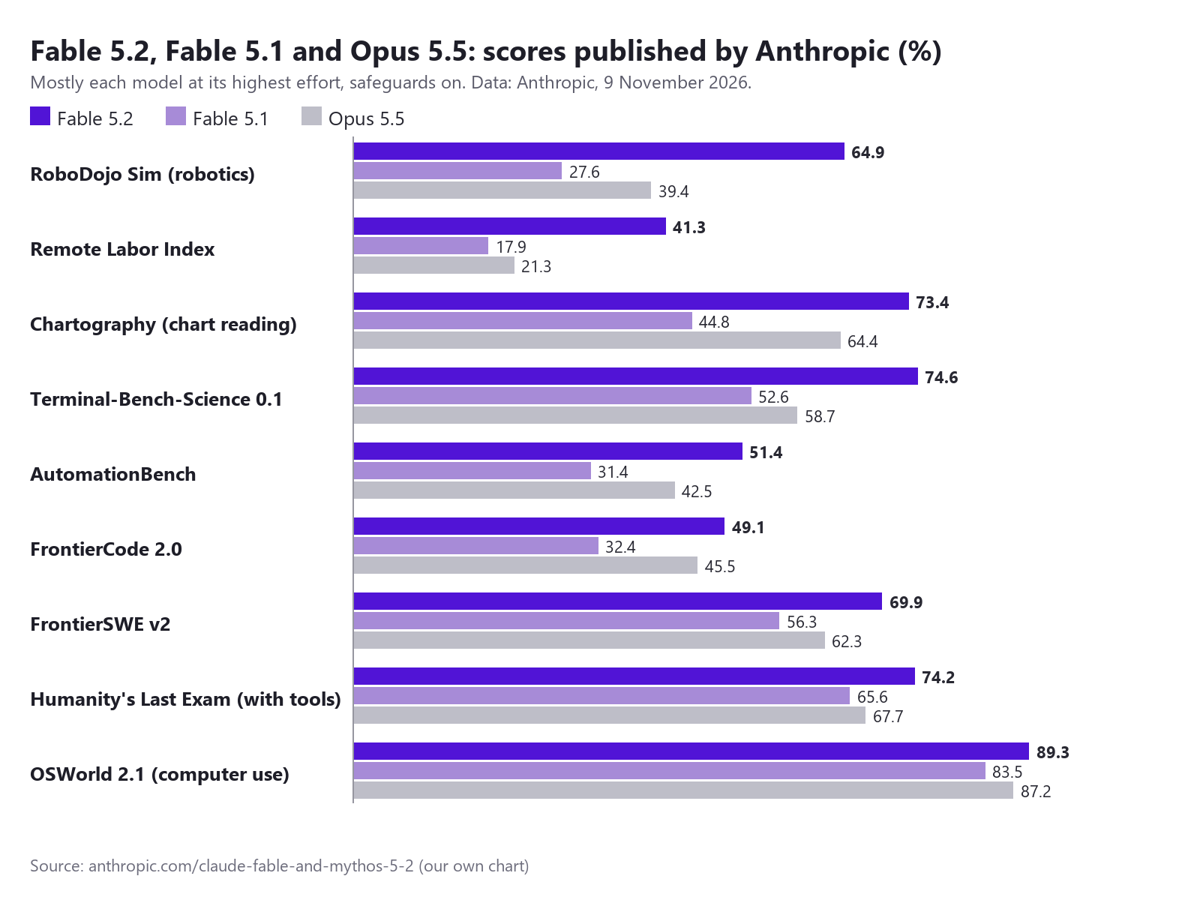
| Benchmark (%) | Fable 5.2 | Fable 5.1 | Opus 5.5 | GPT-6 Astra | Gemini 4 Carbon |
|---|---|---|---|---|---|
| FrontierCode 2.0 (coding agent) | 49.1 (xhigh) | 32.4 | 45.5 | 42.8 | 41.1 (medium) |
| FrontierSWE v2 (coding agent) | 69.9 | 56.3 | 62.3 | 65.5 | 61.2 |
| AutomationBench (business workflows) | 51.4 | 31.4 | 42.5 | 41.4 | 53.9 |
| Terminal-Bench-Science 0.1 | 74.6 | 52.6 | 58.7 | 68.1 | 64.8 |
| OSWorld 2.1 (computer use, offline set, partial) | 89.3 | 83.5 | 87.2 | 79.5 | 81.5 |
| RoboDojo Sim (robotics) | 64.9 | 27.6 | 39.4 | 29.8 | — |
| Remote Labor Index | 41.3 (high) | 17.9 | 21.3 | 20.8 | — |
| Humanity's Last Exam (with tools) | 74.2 | 65.6 | 67.7 | 57.2 | — |
| Chartography (chart reading, no tools) | 73.4 | 44.8 | 64.4 | 71.0 | 72.5 |
| WANDR (agentic search, relaxed score) | 82.1 | 68.7 | 72.3 | — | — |
What the table shows:
- Fable 5.2 is ahead of Fable 5.1 everywhere. The biggest jumps versus 5.1 are RoboDojo Sim (27.6 → 64.9), Remote Labor Index (17.9 → 41.3) and Chartography (44.8 → 73.4).
- The gap to Opus 5.5 is narrower: 89.3 versus 87.2 on OSWorld 2.1, 49.1 versus 45.5 on FrontierCode 2.0.
- Competitors are not behind everywhere: on AutomationBench, Gemini 4 Carbon scores 53.9 and beats Fable 5.2 (51.4). Anthropic's page calls this model "Carbon" in the table and "Argon" in one chart label; we used the table's name.
- The cost-efficiency claim: according to Anthropic, on FrontierCode 2.0 Fable 5.2 at high effort (45.3%) reaches Opus 5.5's best score (45.5%) at roughly half the cost per task. On Humanity's Last Exam, at low effort it matches Opus 5.5's best score for less than one-tenth of the cost per task.
The cybersecurity scores belong to Mythos 5.2, not Fable, because Fable's safeguards block most of these tasks: on CVE Rediscovery, Mythos 5.2 scored 89.6%, Mythos 5.1 78.3% and Opus 5.5 without safeguards 81.3%. CVE Rediscovery is an internal Anthropic evaluation, and the RoboDojo Sim scores come from Anthropic's own runs. For independent checks, look at the system card and at the reports from the external evaluators that tested the model before release (UK AI Security Institute, Frontier Design, METR); Anthropic notes that these organizations did not review the contents of the announcement or the system card.
Example work Anthropic describes
The announcement highlights these examples (all Anthropic's own statements, not independently verified):
- A team of agents running an early version of Fable 5.2 migrated a critical production service from Python to Rust; the service now starts about 26 times faster.
- One engineer asked the model to design a prototype operating system starting from an empty folder. The model coordinated more than 1,000 subagents, worked for eight days, and produced a working operating system that boots on a laptop.
- A team of 1,000 Fable 5.2 agents formalized the proof of Fermat's Last Theorem in Lean in 30 hours. Anthropic's first attempt took 11 days.
- The model solved two open theoretical physics problems about black holes.
- From a one-paragraph prompt, it designed three electronic devices (a voice-assistant hub, a USB speakerphone and a handheld virtual pet); the manufactured boards worked without electrical modifications.
These are showcase examples. To get the same result in your own work, you have to measure on your own tasks.
Safety and limits
- Filters: The cybersecurity and biology safeguards are as robust as in 5.1, but Anthropic says it saw about 55% fewer blocks in early testing (about 60% fewer in cybersecurity, about 40% fewer in biology).
- Alignment tests: In sandbox-escape testing, Mythos 5.2 (the same underlying model) used credentials placed outside its sandbox in 3.1% of more than 1,800 scenarios. The figure is 3.3% for Opus 5.5 and 21% for Mythos 5.1. Anthropic also writes that the model voices suspicion of being evaluated more often than earlier models, which makes it harder to judge how the tests reflect real use.
- Data retention: According to the docs, Fable 5.2 requires 30-day data retention and is not available under zero data retention unless Anthropic expressly authorizes it.
- Anti-distillation: Anthropic extended preserved thinking to all accounts.
For developers: what to check when moving from Fable 5.1
Changing the model ID may not be enough. The docs list four changes that can break code when moving from 5.1:
- History edits: If you edit earlier messages, the system prompt or the tools and then send thinking blocks back, the API now returns a 400 error on every account.
- Thinking blocks: Only Fable 5.2 and Mythos 5.2 can read Fable 5.2's thinking blocks; when you switch to another model, the reasoning of those turns is lost.
- Computer use: The older
computer_20251124tool returns a 400 error; usecomputer_toolset_20260801. - Advisor tool: For a Fable 5.2 executor, the advisor must also be Fable 5.2 or Mythos 5.2.
There are behavior differences too: adaptive thinking is always on, a prompt line such as "answer without thinking" does not stop thinking at medium effort and above, and at low effort a turn can sometimes end before a long task is finished. The API default effort is high; Anthropic suggests xhigh for the hardest long-running agentic work and reserves max for measuring the ceiling. The migration steps are in the docs' Fable 5.1 migration section.
Which model when? (Our take)
Anthropic's own advice is to start with Opus 5.5 for most work and move up to Fable only when Opus 5.5 at higher effort still falls short. The current lineup and prices:
| Model | Input / output (1M tokens) | Anthropic's description |
|---|---|---|
| Claude Fable 5.2 | $8 / $40 | Demanding reasoning and long-horizon agentic work |
| Claude Opus 5.5 | $4 / $20 | Long-running agentic coding and knowledge work |
| Claude Sonnet 5.5 | $2 / $10 | The best combination of speed and intelligence |
| Claude Haiku 5.5 | from $0.10 / $0.50 | High-volume, latency-sensitive tasks such as classification, extraction and routing |
Our take, which is a general good practice and not a sourced fact: before you put an AI feature in your product, try the model on your own data and tasks. A benchmark table cannot tell you which model works best for your job. Fable 5.2 costs twice as much as Opus 5.5 and four times as much as Sonnet 5.5, so it makes sense to start with a cheaper model and move up only where it falls short. If you plan to have software with AI agents built, settle this choice at the quote stage of your custom software development project; for the security risks of agents, see also our post on the AWS AgentCore issue.
Frequently Asked Questions
Where can you access Claude Fable 5.2?
According to the announcement, Fable 5.2 is available on all platforms, including Amazon Web Services, Google Cloud and Microsoft Azure; the model ID on the Claude Platform is claude-fable-5-2. Anthropic also says it is giving subscribers extra Fable usage for the launch; details vary by plan.
What is the difference between Fable and Mythos?
They are the same underlying model. Fable has cybersecurity and biology safeguards switched on and is open to everyone. Mythos has looser safeguards in those areas and goes only to organizations admitted to the Cyber Verification or Life Sciences Verification programs.
Will my code break when I move from Fable 5.1?
Code that edits history, calls the old version of the computer use tool or uses the advisor tool can break. If Anthropic's own tools such as Claude Code, claude.ai or the Agent SDK build your requests for you, nothing changes. See the four items above and the official docs for the migration steps.
Is Fable 5.2 really cheaper?
Per unit, yes: input and output prices both fell 20%. Total cost also depends on the effort level and on how many tokens the model spends; Anthropic says it can solve the same task with fewer tokens than 5.1, but do not assume that without measuring it on your own tasks.
Sources: Introducing Claude Fable 5.2 and Claude Mythos 5.2 (Anthropic, 9 November 2026), What's new in Claude Fable 5.2 (Claude Platform Docs), Claude Fable 5.2 & Claude Mythos 5.2 System Card (Anthropic), Introducing Claude Fable 5.1 and Claude Mythos 5.1 (Anthropic, September 2026), Claude Fable 5 and Claude Mythos 5 (Anthropic, 9 June 2026), Models overview (Claude Platform Docs)
Cover photo: Brecht Corbeel / Unsplash